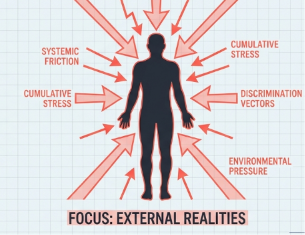
There’s so much wrong with CBT. This was supposed to be a structured post. Lol. Since when do I do that? It had some structure when I was thinking about what I wanted to say, but when I type or write, all structure disappears. I did okay in school, but I never wrote good papers. Not shocking.
I included illustrations by NotebookLM in this post because everyone can agree that what NLM says is true, even though the images are based only on this post. Could this be more accurate than research that publishes findings without testing all their hypotheses? Unsure, but we do have that in common.
Last time I wanted to blog about CBT for autistic adults, I started browsing CBT books, which explains why I never started this entry. This time, I gave an LLM an example of a coworker having a problem with another coworker and told it to basically run through CBT (not an official term). I recognize a lot of it. Is there a CBT support group for people who went through that? The horror!

Anyway, the issue may be that CBT isn’t effective for cumulative stress, so if years of environmental (work, sensory, inequality, trauma, etc.) stress is the issue with an autistic adult, can a therapist work around that? One therapist said the autistic adult (shorthand from here on out: AA) didn’t have anything stressful happen that week, so she didn’t know what to do! This is the problem with traditional therapy. They need things to, uh, happen. Well, the stress is daily and ongoing for the AA.
I’ll get into some specifics of CBT:
Identifying Cognitive Distortions – If the thing is really happening, don’t tell the person it isn’t. That’s #1. CBT gets an F for calling everything a “distortion.” In my coworker example, the coworker may really think the person is incompetent. Say this is a nonautistic and AA dynamic. Nonautistic people often think unfavorably of AA. (If you have no lived experience and are naive, you can easily find this in the research). So you may want to rethink telling your client this is a distortion. Bad assumption.

Update to add research that said autistic people are thought to have high ability but low friendliness. That is a stereotype, I guess. I assure you not everyone thinks I have high ability. If friendly means smiling and being social, then I satisfy the lack of that well. But the point is most people know what is said about unfriendly people. Let’s not pretend (lie) otherwise. And I hear and read what is said about autistic people, so “high ability” for some. Nowhere near all.
Evidence Gathering: Record evidence for and against the thought. Most adult coworkers know not to do something overt in the workplace, so 1 point for CBT. Fair? Well, actually, overt things have happened to me at work, not in front of management, though, but let’s keep ignoring reality. Most things are carefully hidden, so good luck finding evidence for “the distortion.”
Behavioral Experiments: This is getting terrifying. What if the bully attacks? Oh, right. These are just distortions. Not reality. Therapists may want to really confirm all this before starting experiments. The therapist tells the client to test the thought. It might be asking the coworker a neutral question. If the person still seems to hate you, you are not cured. I mean, try again? Accept it, or is that ACT? Keep trying; the coworker will accidentally smile or do whatever you want.
Downward Arrow Technique: The client is still alive. In CBT, that’s a win. Then the therapist moves on to bad questions like: “If it were true that she doesn’t like you, what would that mean about you?” Imagine going through this more than once. Honest answer: I never said I cared if Helen liked me. Are you doing bad mind reading? Tip #2: Don’t assume your client prioritizes “liking.” Ask first. Helen is causing stress. She already told the boss I did something wrong. They talk all the time. I don’t want to have to look for new work and experience hostility from different people, etc. This isn’t about “liking.” It’s about real life. Anyhow, this is supposed to uncover core beliefs. My core belief: Helen is a surface-level thinker. Next?
It’s over. But not really, because the world won’t stop

I can’t believe CBT is real. But I bet some still think it can solve cumulative stress caused by discrimination or hostility. To give some therapists credit, some will admit that they “can’t fix society or autism”. Did the therapist try to fix society? Probably not, but let’s assume that’s true so I can end part I of why are some people still pushing CBT for AA? By the therapist’s response in the study, part of me hopes they don’t get autistic clients because they are beyond clueless, but many AA who have sat through CBT or any traditional therapy already know this. I’m glad the therapists were honest.
Some therapists eventually get it? “ The assumption that this [autistic] person needs to be out in the world doing things with other people- that assumption from me was unhelpful for them, I think” – PT8
Keep trying, PT8. One day you might get it. “Unhelpful.” You think? Telling me that Helen didn’t do what I saw her do and then making me leave the house and be around more Helens? Bad advice.

Part II coming one day
PS – Do I really need to say not only autistic people? There is the minority stress model, and when people mention it, they rarely mention people with disabilities (!!). And I hope saying cumulative stress makes it clear I mean not all AA (only those with cumulative stress), but I think a lot is obvious until I read a research study where the basics haven’t been tested.
Sources
- Miller, P. K., Bowden, S. L., Dewison, N., Ingham, B., Thwaites, R., & Dagnan, D. (2025). ‘Sometimes I’m feeling baffled and they’re probably feeling baffled’: On the experiences of psychological therapists working with autistic people in a structured primary care service for anxiety disorders and depression. Autism, 29(10), 2477-2488. https://doi.org/10.1177/13623613251341610
Common senseLived experience
This Week in Media & Other Things
Music of the Week

Books of the Week
Culpability by Bruce Holsinger (Fiction). My rating: ★★★ (3.50 stars). A book about nothing was my first thought, but I guess it is a moral AI story. I read another book on this topic earlier this year, and it wasn’t good either. I do like books with moral questions, but maybe AI morality isn’t that interesting in fiction. I tried the author’s other book, “The Gifted School”, and it was so boring. I started it 2 or 3 times because the premise was good, but I couldn’t get into it. I didn’t know he wrote both books until I finished this, and wow, kind of obvious. He definitely has a writing style. This book was too long to not have one likable character. I think this book was supposed to be mysterious and compelling, but I was wondering when something was going to happen. This book was way too long with very little happening.
A Monster in Mount Pleasant: A Story of Murders and Justice by C.J. Williams (nonfiction). My rating: ★★★★ (4 stars). I was going to say this is a typical, decently written true crime book, but the author knew two victims and the person who did it, so it’s a little unique. I was familiar with this case and wasn’t going to read it, but I’m glad I did. The author also mentioned interviewing the person who committed the crime almost on the first page, so that kept me reading, but there was very little insight, so anyone expecting that will be let down.
The Senator’s Wife by Liv Constantine (Fiction). My rating: ★★★★ (4 stars). I spent too long debating whether this book deserved a 4.25 rating. This is my third Constantine book. It’s set in DC, which is what made me give this book a chance. I didn’t want this book to end. It’s like a lifetime movie in a good way. But it might be too dramatic for some. My main critique is the ending – it dragged on too long. People call it predictable, but I think that was intentional, given the beginning of the book, so most people will know early on whether they will like or hate it. All predictability isn’t bad. Overall, I enjoyed it and wish it had lasted a little longer.
Quote of the Week

You must be logged in to post a comment.