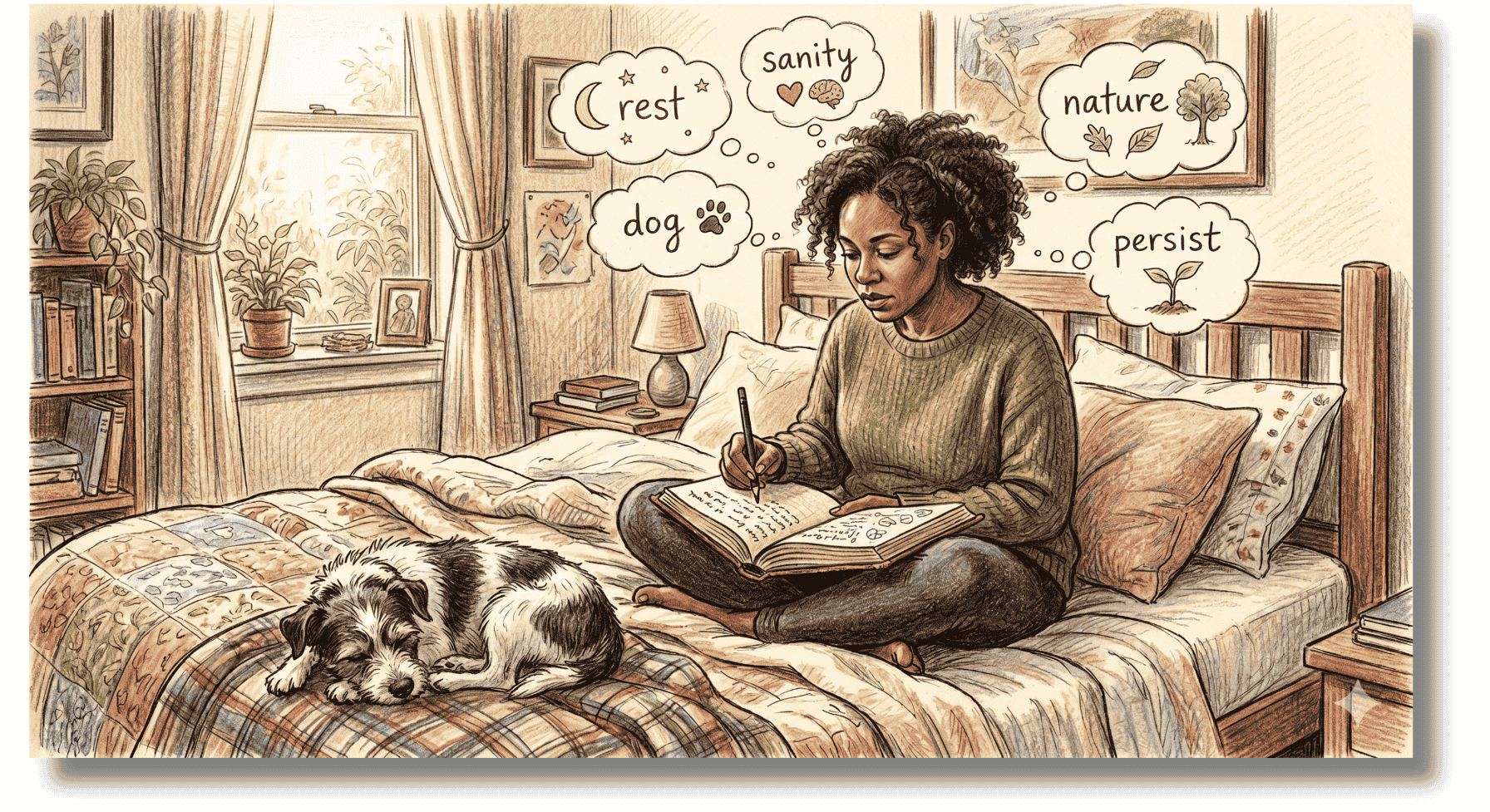
Another year. My only regret about doing these year reviews is going backward, but I’m almost done. I used 2 LLMs for this – a mix of ChatGPT and Gemini. I know everyone hates ChatGPT and is boycotting it, but I won’t poison this entry with thoughts on that. All format issues are my fault, of course.
Summary
2021 looks like a year of chronic overload, a sense of being trapped, and repeated disappointment, but also a year when you kept trying to design a more livable life. The strongest through line is not failure. It is persistence under bad conditions.
Key Reflections of the Year
The defining reflection of 2021 is the cost of survival vs. the price of freedom. You spent much of the year feeling like a “slave to capitalism” and your debtors.
- Environmental Impact: You realized that your physical environment was a major contributor to your mental state. Moving out of your mother’s house was not just a logistical change; it was a desperate bid for “peace and quiet” to manage your sensory processing issues.
- Burnout as a Constant: By December, you explicitly identified as being “burned out”. You reflected on the impossibility of maintaining a 70-hour work week and the toll it took on your ability to “feel like a person”.
- The Diagnostic Journey: A major reflection was the shift from viewing your struggles as personal failures to understanding them as part of your neurodivergence.
- Life structure: You repeatedly describe work as swallowing your life, overtime as taking your rest and sanity, and debt as a form of confinement. You also keep returning to the idea that if you could control your time, your whole life would feel different.
Key Values
- Freedom: Not just financial freedom, but the freedom to “wake up when I want” and walk your dog whenever you choose.
- Quiet/Peace: Due to sensory processing issues, quiet is not a luxury for you; it is a “need, not a want”. Rest, nature, sauna, park trips, beach time, and being left alone are repeatedly associated with relief.
- Autonomy: The desire to “not work for the man” and to have control over your own time.
- Loyalty: Specifically, your bond with your dog, who served as your primary source of emotional stability and companionship throughout every crisis.
- Meaningful work/creativity: You did not just want less work. You wanted work that felt more like yours.
- Being understood accurately: A lot of distress seems to come not only from stress itself, but from feeling unseen, misunderstood, or misread.
Noticeable Thinking Patterns
1. Constraint-focused thinking.
You often scan quickly for what blocks a plan: money, time, dog logistics, utilities, credit score, classes, therapist mismatch, work demands. This is not irrational; many of the constraints were real. But it does mean your mind often lands first on the trap, then only later on options.
2. Fast escalation from uncertainty to worst-case possibilities.
Examples include health fears, job fears, therapist rejection, financial fears, and social conclusions like “no one cares” or “everyone leaves.” The journal shows a tendency for uncertainty to become emotionally total very fast.
3. Repeated “story” making around abandonment, rejection, and lack of support.
You sometimes explicitly catch this yourself, which is important. The most direct example is “Story I’m making up: I have no control over my life. I have no support. No one cares about me.” That suggests some awareness that the interpretation and the facts are not always identical.
4. Ambivalence rather than simple indecision.
A lot of entries are not just “I can’t decide.” They are “this could help / this could be a mistake,” “I want change / change is scary,” “I need support / support disappoints me,” “I want freedom / I need income.” That is a more complex pattern than simple procrastination.
5. Relief is highly situational and concrete.
Your mood often lifts under very specific conditions: no overtime, going to bed early, a trip to the park, quiet, better food tolerance, a walk with your dog, a break from work, a helpful conversation. That suggests your emotional state was strongly tied to load and environment, not just abstract “mindset.” (Shoutout to mindset Molly! Thanks for summing up quickly why Molly is so annoying. Real barriers are not mindset. )

Valuable Insights
- Production vs. Perfection: You realized that your job is not designed for your brain, which thrives on creativity, but rather for a “machine”.
- Realizing fatigue was a serious problem and affected mood/functioning.
- Identifying your negative beliefs directly instead of only living inside them.
- Recognizing “story I’m making up” as a distinct layer, which shows some separation between raw feeling and interpretation.
- Seeing that the problem was partly a mismatch between your values and your unmet needs. That is one of the sharpest conceptual insights in the whole file.
Big Changes of Mind
- On Spirituality: You moved from trying to force practices like A Course in Miracles to admitting they didn’t feel right and “giving up” on formal spirituality in favor of nature and quiet.
- On Living Alone: You moved from being “scared to move” due to credit scores and logistics to realizing that living with your mother was a greater risk to your sanity than living alone in a “bad neighborhood
From ChatGPT – No dramatic worldview reversal stands out (#facts). It looks more like narrowing and reality testing than a big change of mind.
- Early in the year, some thinking is more expansive or fantasy-leaning: Mexico/Costa Rica, big coaching hopes, bigger escape ideas. Later, the thinking becomes more concrete and local: apartment vs. house, utilities, accommodation requests, move fund, scheduling, and specific work changes. (Yes, my living in Costa Rica or Mexico is unrealistic. Ha. Thanks!)
DBT Clinician Recommendations
A Dialectical Behavior Therapy (DBT) clinician would likely focus on the following:
- Radical Acceptance: Practicing acceptance of the “capitalist reality” you currently inhabit. You don’t have to like work, but fighting the reality of the production quotas causes you more “rage” than the work itself. (Eww. Gross. Never doing DBT with a clinician. Thanks for the info, Gemini!)
- TIP Skills (Temperature, Intense Exercise, Paced Breathing): Given your sensory meltdowns and physical reactions to stress, using cold water or engaging in intense movement could help “reset” your nervous system during work-related “errors.”
- Emotion regulation through load reduction, not just thought work.
A DBT clinician would probably take seriously that sleep, overtime, health, noise, conflict, and overstimulation are not side issues. They are central vulnerability factors.
Brief Constructive Feedback
- Gemini: You are incredibly resilient—you moved, maintained a business, and kept a high-pressure job while navigating a medical condition and a new diagnosis. However, your habit of isolating when stressed and pre-emptively rejecting support may be keeping you in a cycle of “unsupported burnout.” Try to view professional support not as someone who needs to “fix” you, but as a “buffer” against the world you find so overstimulating. (UM, I should boycott Gemini for using the word “resilient”. But… It’s an LLM. What are people’s excuses?)
- ChatGPT: Your journaling is very honest, which is useful. But it often stops at pain + analysis. The missing piece is usually one concrete next move. (I don’t plan in my journal as often. Journal is for venting. Sometimes I brainstorm there…I use my note pages in my planner for planning “next steps” IF there are any.)
Short recap for 2021, even though I had 100 entries. But when work dominates, I vent about it. It was worse back then for various reasons I won’t get into right now.
I thought Gemini won, but the word “resilient” is unforgivable. My g-d. Know better. I hate when people say no excuses, but… no excuses. Anyway, this is the first year review I feel removed from. Maybe because I have a completely different living situation? Because nothing else changed. LOL.
Note: I ask for DBT tips because CBT is crap for people who are self-aware and reality-based. (And research shows regular CBT is usually not ideal for autistic adults, but I think the determining factor is whether there’s trauma.) I also didn’t want any positive “life coach” like tips, so I just chose DBT. I might choose another modality next time.
2020 is coming up next…probably a month from today.

Find the ChatBot reviews of each year of my private journal here.
I will keep adding to these posts until I have all the years complete. Not sure how many years I will have…but at least 7.
You must be logged in to post a comment.